Recently, a research team from the Institute for Precision Medicine at Tsinghua University, in collaboration with the First Medical Center of the Chinese PLA General Hospital (301 Hospital), the Department of Respiratory Medicine of the First Affiliated Hospital of Hainan Medical University, and Capital Medical University, published a landmark study in the international authoritative journal Signal Transduction and Targeted Therapy (a Nature sub-journal). The study, entitled “Clinical investigation on nebulized human umbilical cord MSC-derived extracellular vesicles for pulmonary fibrosis treatment,” systematically evaluated the safety and efficacy of nebulized human umbilical cord mesenchymal stem cell–derived extracellular vesicles (hUCMSC-EVs) in the treatment of pulmonary fibrosis.
Pulmonary Fibrosis
Pulmonary fibrosis is a chronic, progressive interstitial lung disease characterized by abnormal scar deposition in lung tissue, leading to thickening and stiffening of the lungs and impaired gas exchange. As the disease progresses, patients typically experience shortness of breath, persistent cough, and fatigue. The pathological process is believed to involve a cascade of inflammatory responses triggered by the activation of immune cells such as macrophages and T cells.
Pulmonary fibrosis is considered to result from multiple factors, including environmental exposure, autoimmune diseases, genetic predisposition, medications, and viral infections. Among these, viral infections such as influenza and coronaviruses are regarded as important triggers, as they can directly damage lung tissue or induce immune and fibrotic responses, exacerbating chronic inflammation and ultimately leading to progressive and difficult-to-treat disease.
Research Findings
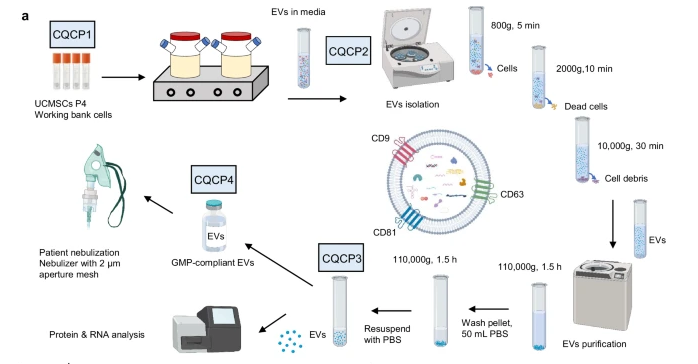
The study established a rigorous manufacturing system to produce high-quality hUCMSC-EVs and performed comprehensive characterization at the levels of miRNA, proteins, and metabolites. Following nebulized inhalation, hUCMSC-EVs were found to predominantly accumulate in the lungs of mice and significantly alleviated bleomycin-induced pulmonary fibrosis. Notable outcomes included an increase in survival rate from 20% to 80%, restoration of lung volume, reduced lung injury, improved oxygen saturation, and enhanced pulmonary function parameters.
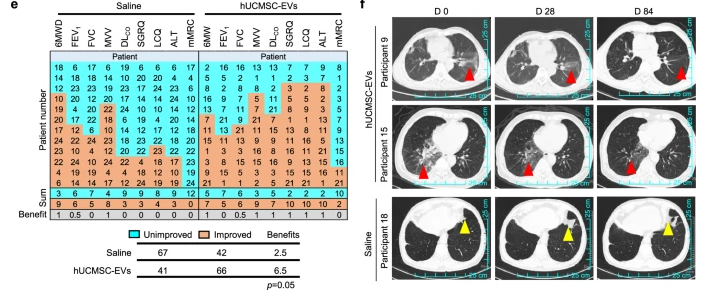
Clinically, the researchers conducted a randomized, single-blind, placebo-controlled Phase I trial (MR-46-22-004531, ChiCTR2300075466) involving 24 patients with pulmonary fibrosis. All participants tolerated nebulized hUCMSC-EV therapy well, with no serious adverse events reported. Patients receiving nebulized hUCMSC-EVs in combination with standard treatment showed significant improvements in pulmonary function indicators—such as forced vital capacity and maximal voluntary ventilation—as well as in respiratory health status, assessed by the St. George’s Respiratory Questionnaire and the Leicester Cough Questionnaire. Overall, patients receiving the combined therapy demonstrated markedly greater benefits than those receiving standard treatment alone.
Notably, two patients with advanced post-inflammatory pulmonary fibrosis showed clinically significant lesion regression on consecutive CT imaging after treatment. These findings suggest that nebulized hUCMSC-EVs represent a safe and promising novel therapeutic approach for pulmonary fibrosis and potentially other pulmonary diseases.
Feellife Supports Exosome Nebulization Research
This study demonstrates that nebulized hUCMSC-EV therapy can improve patient outcomes and can be used in combination with existing treatment regimens. It opens new avenues for the treatment of pulmonary fibrosis and offers renewed hope for improved recovery and quality of life for patients.
However, the biological properties of exosomes are highly complex, and their cargo varies significantly depending on their source and production conditions. Ensuring the stability, bioactivity, and reproducibility of exosomes, and successfully translating them from laboratory research into clinical applications, remain key challenges in this field.
Feellife has long been dedicated to the development and clinical application of vibrating mesh nebulization technology, continuously exploring more precise and safer pulmonary drug delivery solutions. Looking ahead, Feellife will work closely with research institutions and clinical teams to further advance the application of exosome nebulization in pulmonary diseases and provide technical support for clinical translation. We believe that, through innovative nebulization technologies and open scientific collaboration, exosome-based therapies will soon become a powerful force in improving pulmonary health, bringing new hope and possibilities to patients with respiratory diseases worldwide.